

MATERIALS 2
* “constraint-bearing substrates”
* “long-duration world-state”
* “reference frame”
* “canonical identity substrate”
* “Persistence becomes materially encoded, not policy-asserted.”
Gamecraft Materials Ontology
EMS materials are governance substrates.
Each material class encodes:
* structural behavior,
* permissible transformation,
* observability,
* entropy resistance,
* and reversibility characteristics.
The ontology exists to prevent semantic drift across long-duration world-state.
⸻
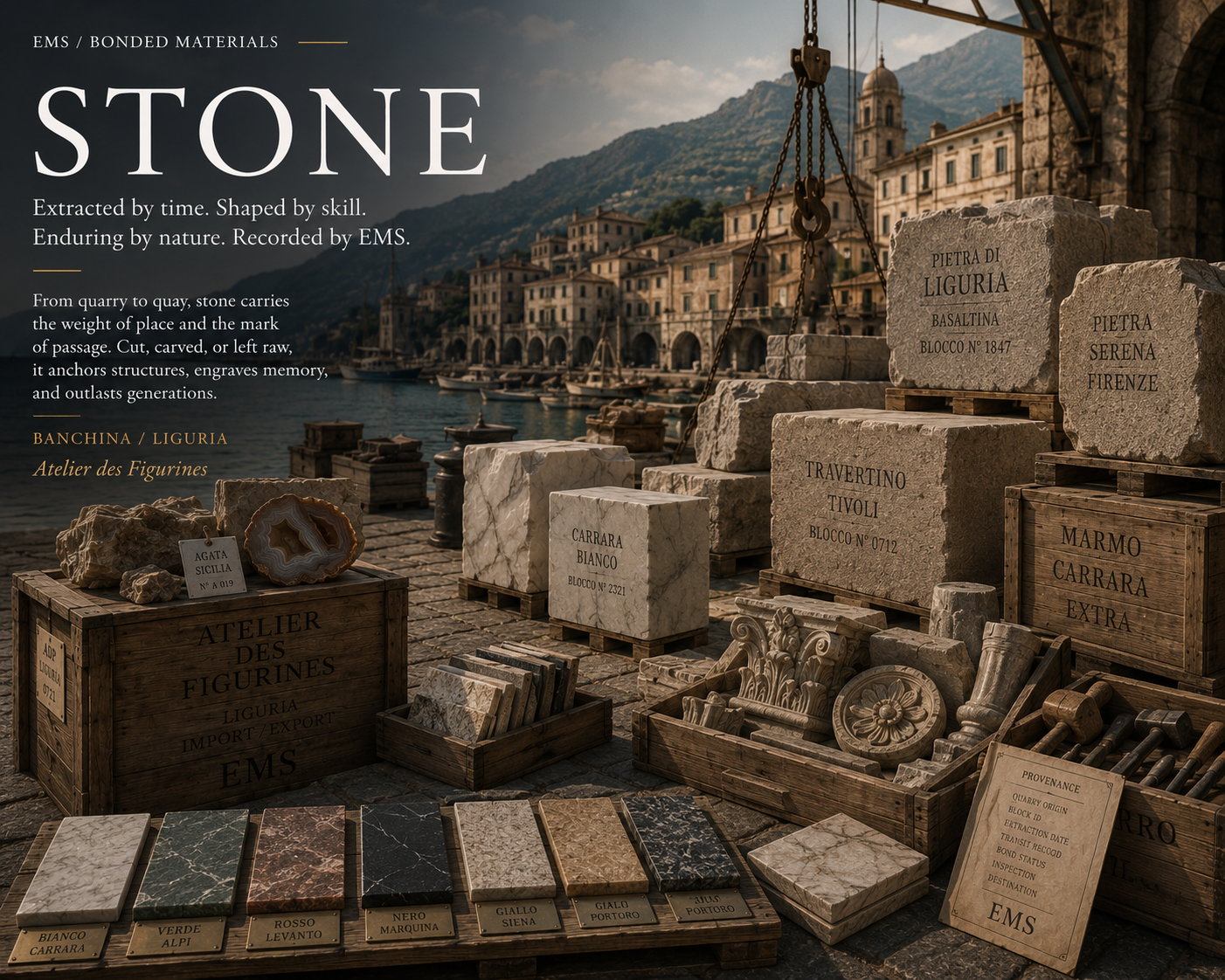
Stone — Invariant Geometry
Stone is the collision authority and terrain truth substrate.
Functions:
* terrain permanence
* load-bearing geometry
* immutable routing
* jurisdictional boundaries
* canonical spatial anchors
Simulation traits:
* high persistence
* low mutability
* deterministic collision behavior
* audit continuity
* entropy resistance
Stone is the reference frame against which all other materials negotiate change.
⸻
Glass — Visibility & Propagation
Glass is the observability manifold.
Functions:
* light transport
* shader truth
* refraction logic
* parallax exposure
* signal propagation
* visibility layering
Simulation traits:
* transparency gradients
* refraction mapping
* distortion detection
* reflection integrity
* wave propagation
Glass reveals hidden adjacency without altering structure.
⸻
⸻
Leather — Adaptive Binding
Leather is the flexible interface substrate.
Functions:
* skins
* bindings
* reversible overlays
* interaction membranes
* covenant surfaces
* adaptive interface layers
Simulation traits:
* adaptive fitting
* reversible edits
* continuity under strain
* wear accumulation
* flexible persistence
Leather mediates between rigid authority and living interaction.
⸻
Anti-Drift Simulation Principle
Materials are governance systems.
Each substrate carries:
* mutation costs and effects
* reversibility limits
* observability rules
* persistence characteristics
Drift occurs when systems behave as infinitely editable surfaces.
The ontology exists to prevent:
* semantic collapse
* authority ambiguity
* render divergence
* uncontrolled mutation
Stone resists entropy.
Glass reveals deformation.
Porcelain preserves identity.
Leather enables reversible adaptation.
Persistence becomes materially encoded, not policy-asserted. And does not alter when alteration finds.
FIL, LE FILETAGE, ENFILER UN CHEMIN, FILETER, FAIRE PASSER
THREAD
EL HILO, LA HEBRA, LA FIBRA, ENSARTAR, ENFILAR
IL FILO, IL FILETTO, LA FILETTATURA, INFILARE
Thread Length, Curvature, and Constitutional Continuity
One of the most common errors in interpreting any complex system is assuming that a short segment reveals the whole path.
It rarely does.
A thread viewed across a few centimeters may appear straight, curved, reversing, or even tangled. Extend the visible portion, however, and the same thread may reveal itself as part of a spiral, a braid, a knot, a repair, or a larger weave whose governing direction was previously invisible.
Length changes understanding.
LOOM, at loomnetworks.com and emsloom.com, exists because constitutional systems are rarely understood through isolated observations. They are understood through continuity.
The longer the visible thread, the more faithfully its governing curvature can be discerned.
Curvature Is Not Direction
Observers often describe a thread by its local behavior.
“It curves.”
“It loops.”
“It reverses.”
Those observations may all be correct while simultaneously being incomplete.
A heavily wound thread can appear to reverse repeatedly while faithfully advancing.
A woolen thread may appear irregular while maintaining remarkable structural integrity.
A braided thread cannot be understood by examining only one strand.
LOOM therefore distinguishes between local curvature and constitutional direction.
The first belongs to observation.
The second belongs to continuity.
Composition Matters
Threads differ not only in length but in composition.
Some are tightly spun.
Some remain loose and organic.
Some carry pigment.
Some carry memory.
Some carry authority.
Some exist primarily to bind.
The composition of the thread influences how curvature should be interpreted.
A rigid metal wire and a linen fiber cannot be evaluated using identical assumptions.
Likewise, constitutional systems composed of law, language, commerce, memory, or stewardship exhibit different forms of continuity despite sharing the same underlying weave.
GNOMON and LOOM
GNOMON and LOOM are complementary, with their foundations at emsgnomon.com and encodedmaterialsystems.com.
GNOMON asks: What is the identity of this artifact?
It measures orientation.
It establishes admissibility.
It evaluates fidelity.
LOOM asks a different question: What larger continuity does this belong to?
It evaluates provenance.
It follows inheritance.
It reveals constitutional curvature.
GNOMON determines whether an object faithfully represents itself.
LOOM determines whether the observer has followed enough of the thread to understand what they are actually seeing.
One protects identity.
The other protects continuity.
Neither replaces the other.
GOLD

PORCELAIN
Porcelain — Semantic Fidelity
Porcelain is the canonical identity substrate.
Functions:
* precision artifacts
* heirloom entities
* lineage-preserving renders
* ceremonial objects
* fragile high-resolution state
Simulation traits:
* semantic continuity
* high detail retention
* low deformation tolerance
* lineage preservation
* controlled brittleness
Porcelain preserves meaning under replication.

Opal


AGATE


LIMESTONE

AEGEAN SEA 1200 BC
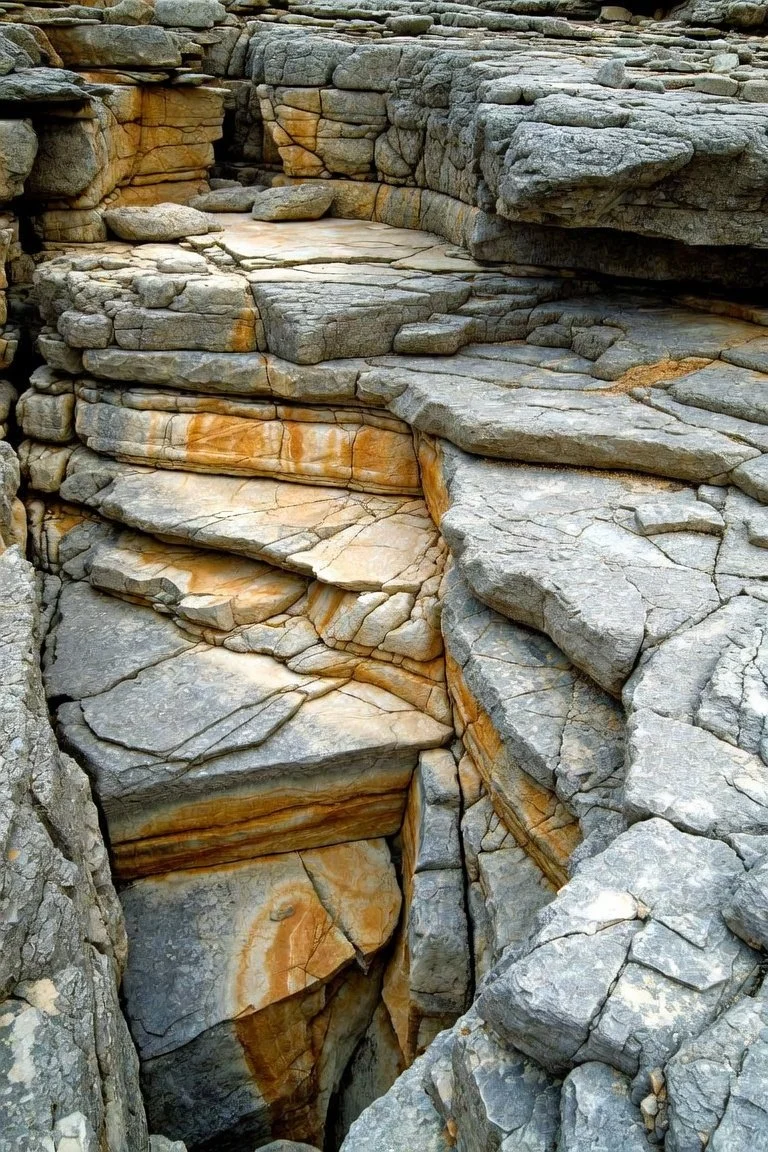
Sedimentary planes can reveal substrate layers through erosion.